 Rafael Baptista
My first real 3D printer
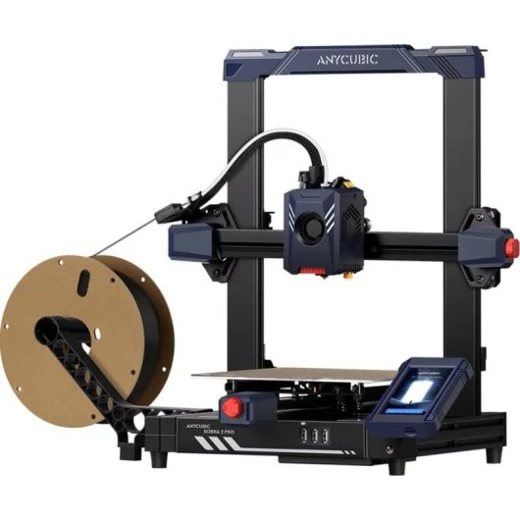
I had been designing things in SketchUp for years; in April 2024 I finally got a printer to make them real: the Anycubic Kobra 2 Pro. An open-frame, fast bed-slinger that is a great way into 3D printing - and a great way to find out exactly what you need from your next printer.
Guide: from idea to print
1. Measure first
Most of what I print has to fit something that already exists: a charger, a headset, a shelf. Callipers and a few test pieces save hours - print a small slice of the part that has to fit before printing the whole thing.
2. Design
I model in SketchUp and keep the printer in mind while designing: flat faces down on the bed, as few overhangs as possible, and walls that are a multiple of the nozzle width so the slicer does not leave thin gaps.
3. Export and slice
Export the model as STL (or 3MF) and open it in the slicer. The settings that matter most:
- Layer height - thinner layers look better, thicker layers print faster.
- Walls and infill - strength comes mostly from walls, not from infill.
- Supports - only where overhangs really need them.
- Orientation - layer lines are the weak direction, so turn the part so the load does not pull them apart.
4. Print, check, adjust
Clean the bed, watch the first layer, and change one setting at a time when something goes wrong.
Tricking it into two colours
The Kobra has one extruder and one filament path, so officially it prints one colour. The trick is a pause at a chosen layer height: the printer stops, you swap the filament for another colour, and it carries on. That works for things like raised text or a logo on a flat plate - colour changes per layer, never side by side in the same layer.
Where it hit its limits
- Size: some designs simply did not fit on the bed and had to be split into parts and glued.
- Colour: two colours by swapping filament by hand is as far as it goes.
- Temperature: it cannot print the high-temperature filaments some of my projects need - those also want an enclosure, and the Kobra is open.
- Cost: every new material means another spool, and with many different types of filament on the shelf it got expensive fast.
It taught me a lot about printing and about what to look for next. That next printer is the Bambu Lab H2C.